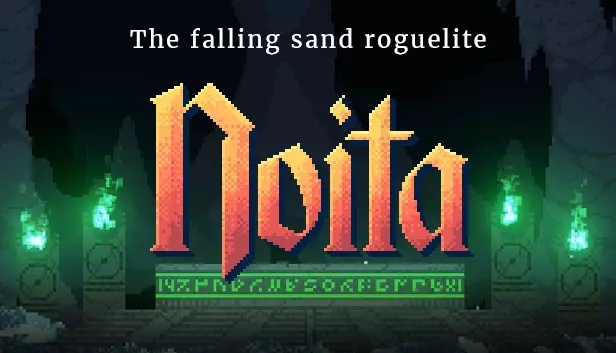
The standard introduction to Noita portrays it as a single-player video game where a witch explores a procedurally generated, 8-bit, 2D world, yet this description barely scratches the surface of its mechanical complexity. At its core, the game operates on a custom-built engine where every single pixel is physically simulated, creating a highly reactive environment where materials interact according to distinct chemical and physical laws. The narrative and thematic framework of this unforgiving world are deeply intertwined with the Karelian and Finnish national epic, the Kalevala, embedding cultural mythology directly into the gameplay loop. Players do not simply fight generic monsters, instead, they confront enemies inspired by ancient lore, such as the subterranean Hiisi factions or the terrifying aquatic entity Iku-Turso. From the moment the opening cutscene concludes and control is granted at the mouth of a dark cave, the ultimate objective becomes clear, which is to delve into the depths, survive the hostile ecology, and secure the legendary Sampo.
The Falling Everything Engine and Pixel Simulation
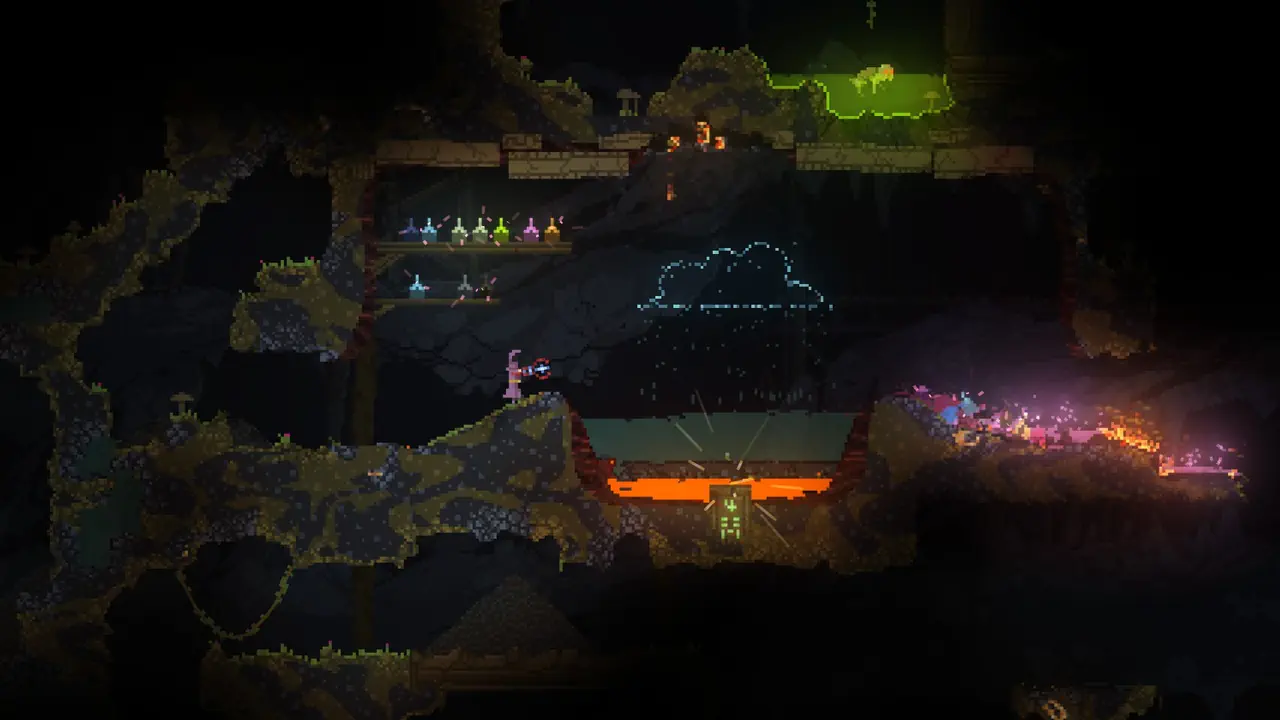
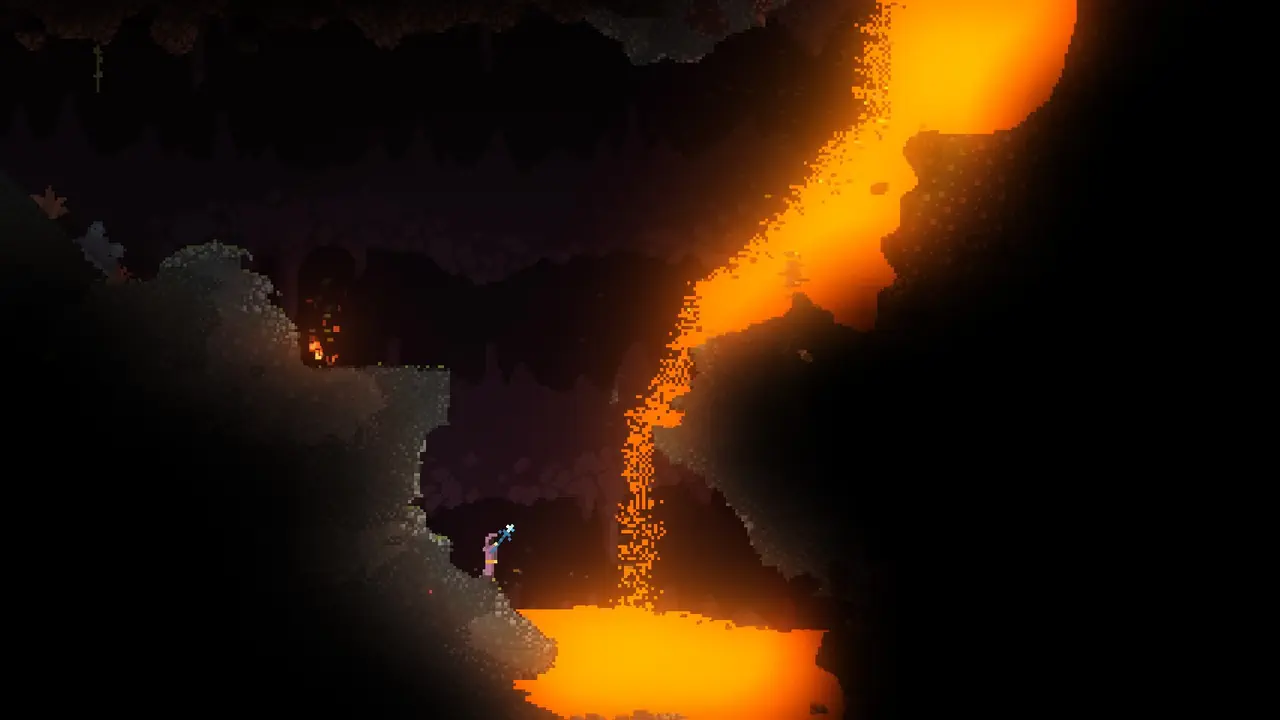
The foundation of gameplay relies entirely on the proprietary Falling Everything engine, a technological marvel where every pixel possesses individual properties, mass, and material interactions. Unlike traditional sandboxes where terrain is static or destructible in blocks, this world allows players to burn, explode, melt, or freeze every element on screen. Wood burns into charcoal, columns of rock melt into glowing lava, and pools of acid eat through metal barriers to create emergent pathways. Liquid dynamics are equally sophisticated, allowing players to douse themselves in water to extinguish flames, or even swim through the blood of fallen enemies to avoid catching fire. This hyper-interactive simulation transforms the environment from a mere backdrop into a chaotic, living participant in every combat encounter, meaning that a single stray spark can trigger a catastrophic chain reaction.
Wand Crafting as a Sorcerous Programming Language
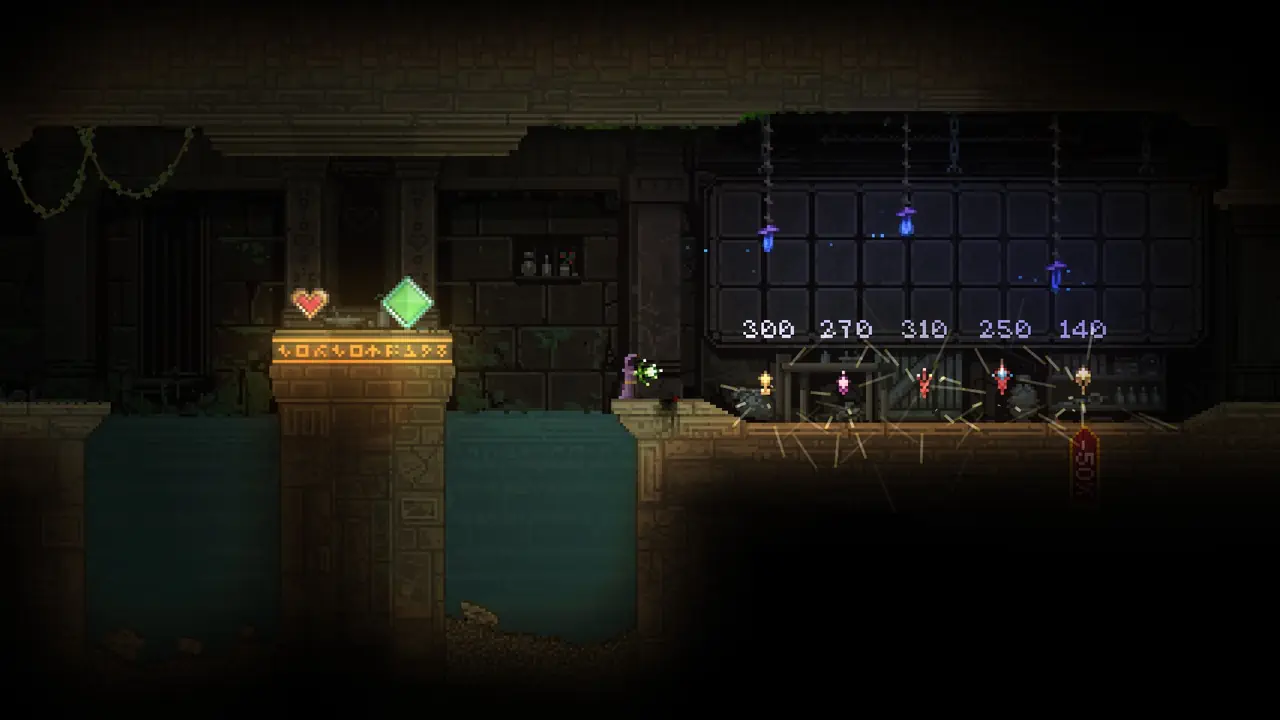
Magic in this universe is not a rigid system of pre-defined abilities, rather, it functions as an intricate, logical programming language centered around wand crafting. Throughout their journey, players discover distinct wands and a vast array of volatile spells, which must be meticulously arranged to maximize efficiency. Each wand features unique underlying statistics, including mana max, mana recharge speed, cast delay, and recharge time, which dictate how rapidly the socketed magic can be unleashed. By combining projectile types with spell modifiers, triggers, and timers, players can construct truly world-shattering armaments, such as a simple spark bolt that delivers a payload of cluster bombs upon impact. This deep system rewards intellectual curiosity and mathematical optimization, though it also introduces immense risk, as an improperly configured wand can easily result in self-destruction.
The Vertically Layered Biomes and Hidden Geography
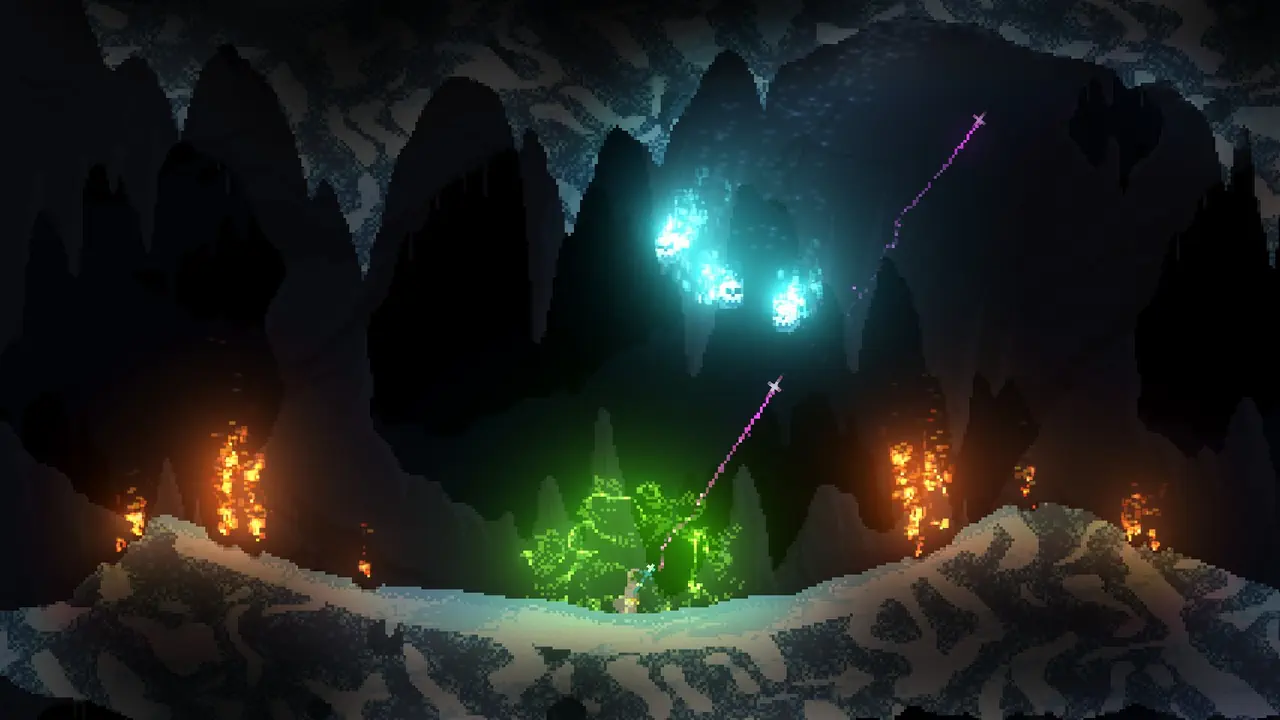
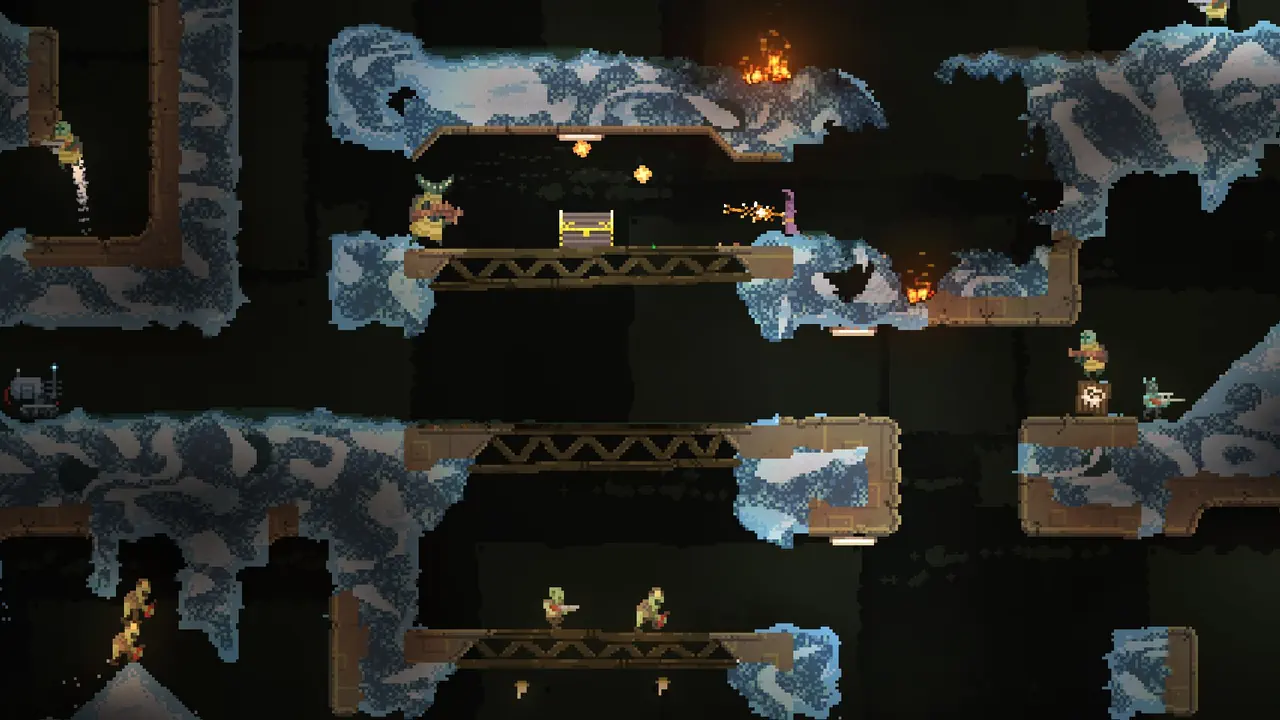
The structural progression of the main path consists of eight distinct biomes stacked vertically on top of one another, forcing a continuous, claustrophobic descent deeper into the earth. The journey begins in the damp Mines, progresses through the combustible Coal Pits, navigates the freezing hazards of the Snowy Depths, and breaches the heavily armed military installations of the Hiisi Base. Beyond these zones lie the dense foliage of the Underground Jungle, the mechanical horrors of The Vault, the reality-warping dangers of the Temple of the Art, and finally, the sterile, ominous environment of The Laboratory. Each environment introduces specific topography, unique enemies, and exclusive spells, giving every layer a distinct tactical identity. At the absolute bottom of this descent resides the massive boss creature, Kolmisilmä, a guardian that must be defeated to claim the Sampo, an artifact necessary to complete the primary cycle of the game.
Beyond the Main Path and the Philosophy of Hubris
While the vertical path provides a clear objective, the true scale of the map extends infinitely in horizontal directions, concealing massive secrets that are completely detached from standard progression. Intellectual players will quickly realize that the rock walls of the main path can be breached, leading to vast deserts, ancient pyramids, parallel worlds, and highly challenging mini-bosses that guard legendary artifacts. Because the game is an uncompromising action roguelite, permadeath is a permanent certainty, meaning that a single mistake will erase all physical progress instantly. This design philosophy reframes death not as a punishing failure, but as a vital educational tool, encouraging players to analyze their mistakes, respect the environment, and overcome the inherent hubris that usually leads to their demise.
The Minds Behind Nolla Games
The development of this complex simulation is driven by Nolla Games, an independent studio founded by a trio of celebrated developers whose previous individual projects heavily influenced the design philosophy of their collaborative masterpiece.
Petri Purho
Widely recognized in the independent gaming community, Petri Purho achieved critical acclaim as the creator of Crayon Physics Deluxe, a title that won the Grand Prize at the Independent Games Festival. His design philosophy has long centered on physics-based ingenuity, emergent solutions, and playful experimentation, traits that heavily inform the reactive nature of the world. In addition to his commercial success, he spent years developing rapid prototypes and experimental freeware titles, building a deep understanding of minimalist yet highly engaging mechanics. His secret passion for designing intricate tabletop board games further highlights his obsession with complex, interlocking systems and rule sets.
Olli Harjola
Bringing a distinct atmospheric and philosophical depth to the team, Olli Harjola is famous for creating The Swapper, an award-winning, mind-bending science fiction puzzle game utilizing claymation aesthetics. His expertise lies in crafting tight, logical puzzles, manipulating gravity, and exploring eerie, isolated environments, which translates directly into the tense, atmospheric subterranean world. Outside the realm of traditional game development, he frequently experiments with acoustic composition, live visual synthesis, and the creation of custom programming languages. This profound interest in algorithmic logic provided the structural foundation for the modular, programmable nature of the wand mechanics.
Arvi Teikari
Operating under the well-known moniker Hempuli, Arvi Teikari is a prolific creator who has released an astonishing number of small, highly experimental games over the course of his career. He is best known as the brilliant mind behind Baba Is You, a revolutionary puzzle game where players physically manipulate literal blocks of text to alter the rules of the game world. His unique ability to look at traditional game design from an inverted, rule-breaking perspective is highly visible in the sandbox freedom of the spells. His mastery of logical manipulation ensures that players are continuously surprised by how different systems interact, rewarding those who dare to test the absolute limits of the engine.
Final Thoughts
Ultimately, the game stands out as a masterclass in emergent design, transforming what could have been a standard side-scrolling adventure into a brilliant, volatile laboratory of chemical reactions and sorcery. By discarding rigid restrictions and trusting the player to navigate the immense danger of its systems, it creates a deeply rewarding loop of discovery where knowledge is the only permanent upgrade carried across runs. It remains a testament to the power of systemic game design, challenging modern audiences to think critically, experiment wildly, and embrace the beautiful chaos of a world where every single pixel can be their salvation or their doom.
What you need to run
Minimum System Requirements
| Component | Specification |
|---|---|
| OS | Windows 7 64-bit |
| Processor | Intel Core i3 / AMD Ryzen 3 |
| Memory | 4 GB RAM |
| Graphics | GeForce GTX 560 / Radeon HD 6870 |
| Storage | 2 GB available space |
Recommended System Requirements
| Component | Specification |
|---|---|
| OS | Windows 10 64-bit |
| Processor | Intel Core i5 / AMD Ryzen 5 |
| Memory | 8 GB RAM |
| Graphics | GeForce GTX 960 / Radeon RX 460 |
| Storage | 2 GB available space |
Have fun!